Yodeck
$1,440–2,160
A complete digital signage CMS for TVs, video walls and kiosks — scheduling, playlists, remote control and proof-of-play. Every competitor bills you per screen, every month. We don't. Self-host it free, or use our managed cloud.
Not sure what to run it on? See certified hardware →
MIT licensed. Self-host on your own infrastructure or use our managed cloud. Your data, your rules.
github.com/screentinker/screentinkerNo proprietary hardware, no complicated setup.
Install the free player on an Android TV, Fire TV, Raspberry Pi, BrightSign, Samsung Tizen or a Windows PC. Or just open a browser tab. Then pair it with a code.
Upload images and video, build playlists and multi-zone layouts, or design screens with built-in widgets.
Assign content to displays or groups, set day/time schedules, and push live. Change it any time from your phone.
Every feature you'd expect from an enterprise digital signage CMS: video walls, scheduling, proof-of-play, and remote monitoring. All free and open source.
ScreenTinker speaks the Model Context Protocol. Point Claude, or any MCP client, at your server and ask it in plain English — “what’s offline?”, “put this video on the lobby screen”. Set it up →
A battery ESP32 and an e-paper panel, with no browser on the device. The server renders and dithers the frame, tells the board how long to sleep, and answers 304 when nothing changed so it never wakes the panel for nothing. How it works →
Panels switch themselves off outside opening hours and back on before the doors do. Per screen or per group, on a calendar.
A wall of screens starts the same frame at the same moment — and keeps doing it with the internet unplugged.
One screen on a site pulls a video once and hands it to its neighbours over the LAN. A whole store updates on one download.
Put a server in each region and let screens connect to the nearest one. Thousands of displays without one box carrying them all.
OIDC per organisation with DNS-verified domains, so staff sign in with the account they already have.
TOTP from any authenticator app, with recovery codes. Included, not an enterprise upsell.
Support can only look inside your account after you grant it, for a window you choose, and every action is logged.
Screens that are portrait in hardware — menu boards, wayfinders — fill edge to edge without a rotation hack.
Extend ScreenTinker with plugins: extra widget types, data-source connectors, and event hooks, without forking core. Trusted local code on a self-hosted node, off by default.
Upload a PDF and every page becomes a full-screen slide, rendered in the browser. No manual export step.
Connect a calendar (iCal / Webcal) to show live Busy / Available, agendas and the next meeting, in every language the dashboard speaks.
Split screens into zones with a drag-and-drop editor. 7 built-in templates or create your own.
Combine multiple displays into one giant screen. Automatic bezel compensation. Any grid size.
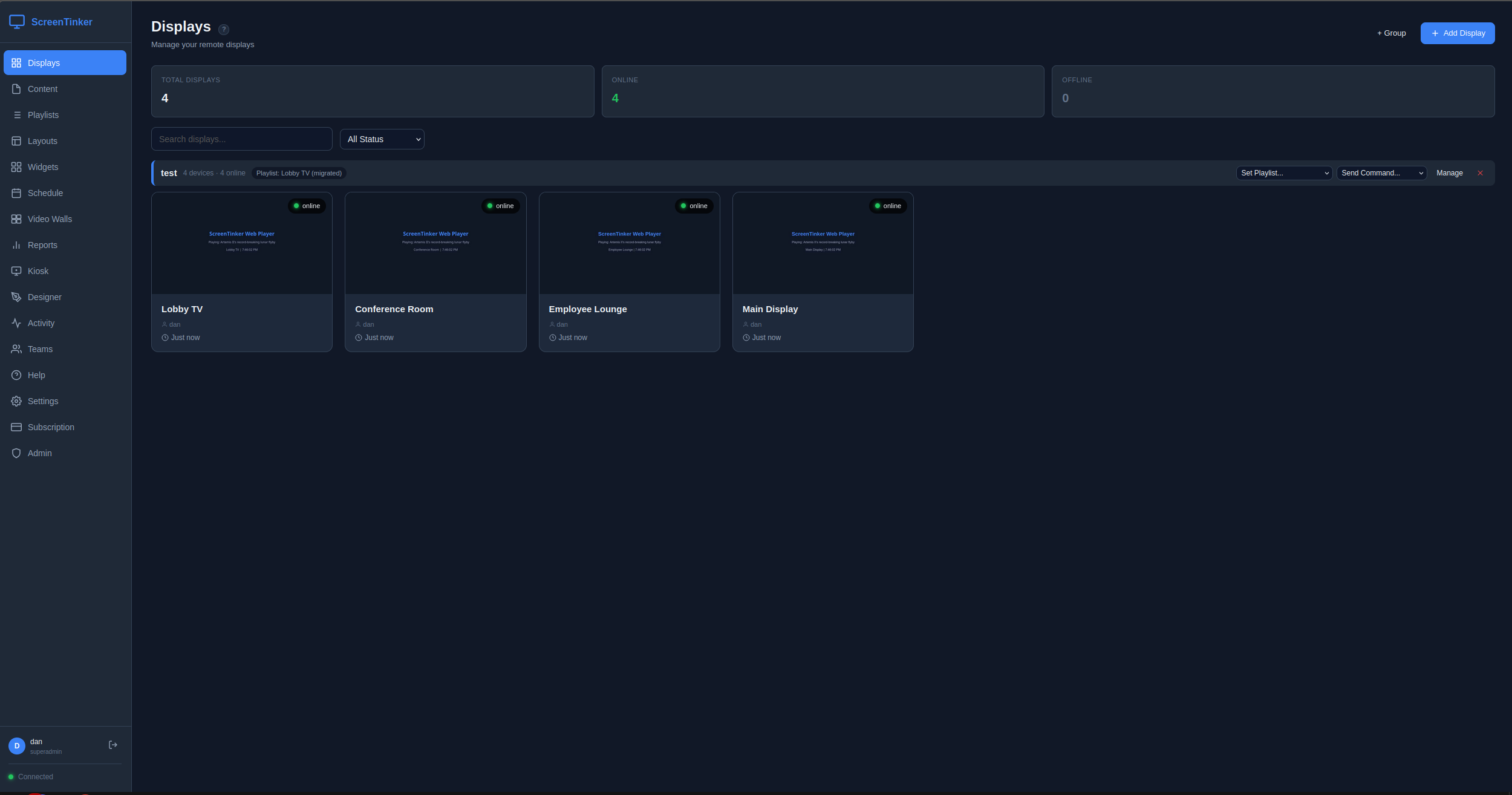
See what's on screen in real-time. Send key presses, navigate menus, power on/off remotely.
Visual weekly calendar with recurrence rules. Schedule per device or for whole groups. Device rules override the group.
Share one playlist across many displays. Draft changes, preview, then publish. Or revert to the last published version.
Scrolling lobby, building, and staff directories. Categories, dark & light themes, anti-burn-in. Not found in any other open-source CMS.
Design a slide properly, with headlines, photos, panels and rules, plus live clocks, dates, countdowns and QR codes on the slide itself. Add a voiceover per slide, or music under the whole deck.
Let a Crestron or Extron panel, a PLC or a button put a playlist over whatever is showing. Resolved on the screen itself, so an alarm still works with the internet down.
Create interactive touchscreen interfaces. Wayfinding, directories, check-in screens.
Track what played, when, and on which device. Export CSV reports for ad verification.
Email alerts when devices go offline. Full telemetry: battery, storage, WiFi, uptime.
Displays keep playing cached content when the internet or your server drops. They catch up automatically when you're back.
Manage everything from your phone. The full dashboard works on any mobile browser, so there is no separate app to install.
Deploy on your own infrastructure. Your data never leaves your network. Lock down signups with a single env var.
Custom branding, colors, logo, and domain. Resell under your own brand.
Separate workspaces per client or site, with owner, editor and viewer roles. Invite by email, or sign in with your own identity provider.
Devices automatically update when you push a new version. Zero manual intervention.
One platform, every use case.
Menu boards, promotions, and price updates pushed to every location instantly.
Digital menu boards with dayparting. Breakfast, lunch, and dinner menus that switch themselves on schedule.
The LED processor hands the wall’s native resolution to the player over EDID, so a 2808×648 wall is just a screen with an odd shape. ⚠️ Streaming sticks can’t drive one — they only output standard resolutions — so use a Raspberry Pi or a small PC. Verified in production by Watterott electronic. LED wall guide →
Lobby welcome screens, meeting-room signs, KPI dashboards, and internal comms.
Campus announcements, event calendars, and emergency alerts across every building.
Waiting-room info, wayfinding, and check-in kiosks that keep playing even offline.
Free, self-hostable signage for lobbies and sanctuaries with no recurring cost.
Class schedules, promos, and live directories on any screen you already own.
Scrolling lobby, tenant, and staff directories with categories and anti-burn-in.
No hardware lock-in. Use any screen you already have — every platform has its own setup guide, and every player is downloaded from your own server.
Browse certified hardware, with prices →All plans include remote control, monitoring, and unlimited content
| ScreenTinker | Yodeck | OptiSigns | ScreenCloud | |
|---|---|---|---|---|
| Billing model | Flat per plan — extra screens free | Per screen, per month | Per screen, per month | Per screen, per month |
| Price (15 screens/yr) | $989 | $1,440–2,160 | $1,620–2,430 | $3,600–5,400 |
| Price (50 screens/yr) | $1,989 | $4,800–7,200 | $5,400–8,100 | $12,000–18,000 |
| Cost per screen/month at 50 | $3.31 | $8–12 | $9–13.50 | $20–30 |
| Free tier | ✓ 1 device | ✓ 1 screen | ✓ 3 screens | ✗ |
| Self-Hosted | ✓ Only us | ✗ | ✗ | ✗ |
| Source you can read and change | ✓ Open source | ✗ | ✗ | ✗ |
| Video Wall | ✓ Included | Basic | Paid add-on | Basic |
| Live screen view + remote key presses* | ✓ All plans | Limited | Limited | Limited |
| Kiosk/Touchscreen | ✓ Included | ✓ | ✓ | Limited |
| Proof-of-Play | ✓ All plans | Paid tier | Paid | Paid |
| Display power schedules | ✓ All plans | Player-dependent | Player-dependent | Player-dependent |
| E-paper / microcontroller displays | ✓ Server-side rendering | ✗ | ✗ | ✗ |
| Control from an AI assistant (MCP) | ✓ Built in | ✗ | ✗ | ✗ |
| Site-local content distribution | ✓ Node mesh | ✗ | ✗ | ✗ |
| White Label | ✓ Included | Paid | Paid tier | Enterprise |
| Email Alerts | ✓ All plans | Paid | Paid | Paid |
| Platforms supported | 11, incl. e-paper | Own player + a few OS | Several | Several |
* Live screen view + remote key presses is Android only and requires granting the on-device accessibility permission.
Prices read off each vendor's own pricing page on 24 September 2026. Ranges are their cheapest to mid tier at that screen count, on annual billing where they offer it; ours is the annual price of the plan that covers those screens. Spot an error? Open an issue on GitHub and we'll fix it — and say who found it.
Setup guides and honest comparisons.
Everything you need to know about running open-source digital signage.
Yes. ScreenTinker is free and open source (MIT licensed). The free cloud plan runs 1 display with 500 MB of storage, and if you self-host there's no per-screen fee at all, so you can run as many displays as your own server can handle. New accounts also get a 14-day Pro trial (15 displays) with no credit card required.
Yes. A Raspberry Pi 4 or newer makes an excellent low-cost signage player. Our one-line installer sets up kiosk mode, auto-start, and pairing for you. See the full walkthrough in our Raspberry Pi digital signage guide.
Yes. Install the free APK on any Android TV box or Amazon Fire TV Stick to turn it into a managed signage display, complete with kiosk mode and live remote control. Step-by-step instructions are in our Android TV & Fire TV guide. ScreenTinker also runs on BrightSign players, Windows, ChromeOS, LG webOS, Samsung Tizen, and any web browser.
Yes. A BrightSign runs the same web player the browser does, so it gets the same playlists, layouts, scheduling and remote control as every other screen. It can even run the ScreenTinker server itself, so a small site needs no separate box. Most open-source signage never supports BrightSign at all.
With cloud, we host everything and you just sign in. That is the fastest way to start. With self-hosting, you deploy ScreenTinker on your own server or VPS so your content and device data never leave your network, with no recurring SaaS fees. You can switch later. Our self-hosted digital signage guide covers sizing, deployment, TLS, and backups.
Yes. The full platform is released under the permissive MIT license on GitHub. You can read the code, self-host it, modify it, and even white-label it. No vendor lock-in and no proprietary black box.
Images, video, playlists, multi-zone layouts, and live widgets: clocks, weather, RSS tickers, countdowns, QR codes, web pages, and scrolling lobby/staff directories. You can schedule different content by day and time, per display or per group.
Yes. ScreenTinker players cache their content locally and keep playing during an internet or server outage, then sync automatically once the connection returns. No blank screens.
Yes, on every plan. See a live view of what's on each screen, push content instantly, and send remote key presses or power commands. (Live view and key presses on Android require the on-device accessibility permission.)
On cloud plans, your display count is set by your tier (1 free, up to 15 on Pro, more on Enterprise). If you self-host, there is no built-in device cap. You're limited only by your own hardware.
ScreenTinker is typically a fraction of the price at scale and is the only one of the four you can self-host. See the detailed breakdowns: vs Yodeck, vs ScreenCloud, and vs OptiSigns.
14-day free Pro trial. No credit card required. Set up in under 5 minutes.
Start Free Trial